
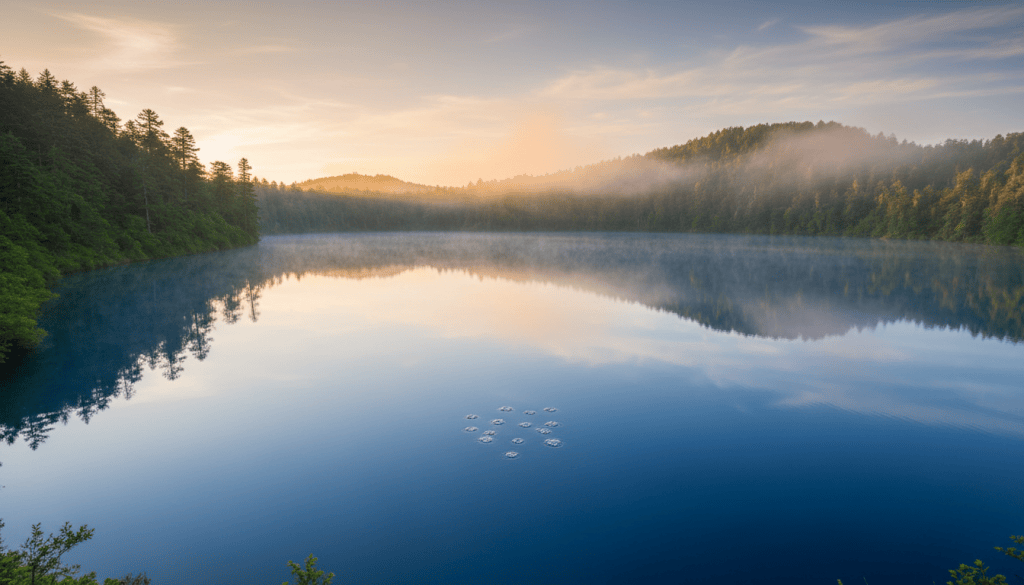

Most lakes are calm places for swimming, fishing and skipping stones. But scientists know of a few rare lakes that hide a strange secret deep below the surface: huge amounts of gas, packed into the water like the fizz in a sealed bottle of soda. Once in a very long while, that gas can rush out all at once. Scientists call this a limnic eruption, and it is one of the most unusual things water can do. Here’s how it works.
A Lake That Holds Its Breath
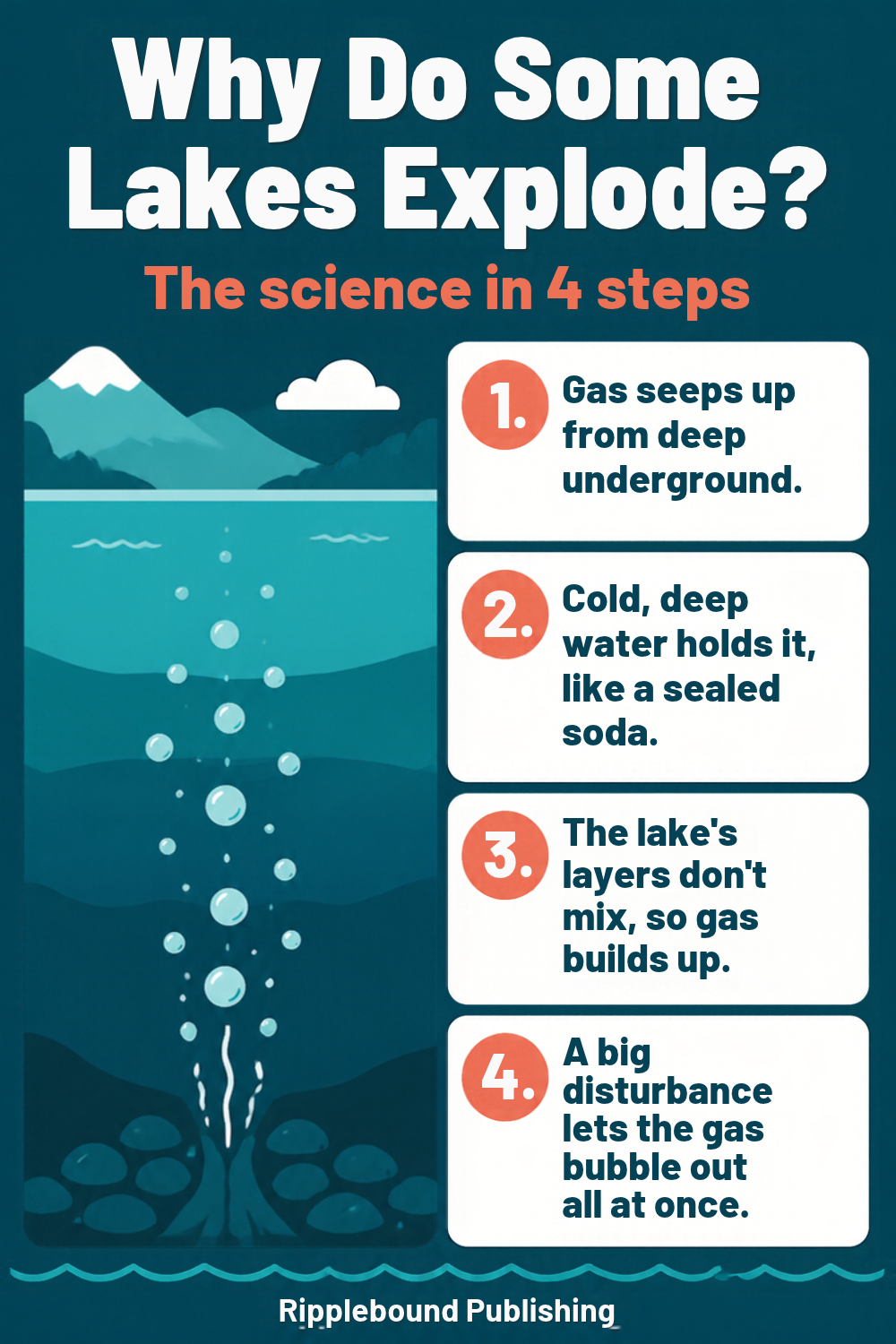
Some lakes sit inside old volcanic craters. Far beneath them, magma (melted rock) gives off carbon dioxide, the same gas that makes soda fizzy. That gas slowly seeps up through cracks in the ground and into the bottom of the lake.
Deep lake water is cold, and it is squeezed by the weight of all the water above it. Cold, high-pressure water can hold a lot of dissolved gas, the way a closed soda bottle holds its fizz. In these special lakes, the water also forms layers that barely mix. The heavy bottom layer stays at the bottom year after year, quietly collecting more and more gas.
When the Fizz Escapes
Think about what happens when you open a bottle of sparkling water. The pressure drops, and suddenly bubbles appear everywhere. A gas-filled lake works in a similar way. If something pushes deep water upward, the pressure on that water drops and the gas comes out as bubbles. Scientists think a landslide, a strong wind or a sudden change in the water could start it, though the exact trigger isn’t always known.
Once bubbles start rising, they pull more deep water up with them, which releases even more gas. It becomes a chain reaction. Carbon dioxide is heavier than air, so a large cloud of it can flow downhill like an invisible river and push away the oxygen that people and animals need to breathe.
Real Lakes, Real Lessons
Limnic eruptions are very rare. The best-known one happened at Lake Nyos in Cameroon, in central Africa, in 1986. A huge gas release flowed into nearby valleys, and about 1,700 people lost their lives, along with many animals. Two years earlier, a smaller release had happened at Lake Monoun, also in Cameroon. These were real tragedies for real families, and scientists studied them carefully so they would be far less likely to happen again.
Their solution was clever. Starting in 2001, engineers placed pipes in Lake Nyos that carry gas-rich water up from the bottom, so the gas can escape a little at a time, like opening a soda cap very slowly. Lake Kivu, a much bigger lake between Rwanda and the Democratic Republic of the Congo, also holds dissolved gas. Scientists watch it closely, and some of its methane gas is even collected and used to make electricity.
Try This: Two Kitchen Experiments
Experiment 1: The Fizz Test (ask an adult to help)
- Hold up a clear, unopened bottle of sparkling water. Look closely: you’ll see very few bubbles.
- Point the bottle away from faces and twist the cap open slowly. Listen for the hiss.
- Watch the bubbles appear. The gas was there all along. Lowering the pressure let it come out, just like deep lake water rising toward the surface.
Experiment 2: Layers That Don’t Mix
- Fill a clear glass jar halfway with cold tap water.
- In a cup, mix warm (not hot) water with a few drops of food coloring.
- Pour the colored water very slowly over the back of a spoon so it lands gently on top.
- Look from the side. The warm water floats in its own layer because it is lighter (less dense) than cold water. In gas-filled crater lakes, the cold bottom layer is heavy too, so it stays put for a very long time.
Talk about it: Why do you think scientists chose to let the gas out slowly instead of all at once? What other everyday things have gas hiding inside them? If you were a scientist, what would you measure to keep a lake safe?
Read More Real Water Science
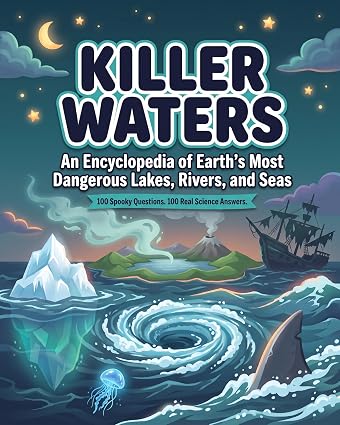
Killer Waters: An Encyclopedia of Earth’s Most Dangerous Lakes, Rivers and Seas
- 100 illustrated entries in 10 chapters, for curious readers about 8 to 12
- Opens with a chapter called “Lakes That Can Kill”
- Every entry has a spooky question, a short answer and the real science
- Plus a danger rating and a survival tip for each place
Science is often strangest when it’s true. If your young reader loved learning how a lake can “hold its breath,” there are a hundred more real places waiting in Killer Waters, each one explained calmly and clearly, with a tip for staying safe.

From Ripplebound Publishing · Kids’ Books
As an Amazon Associate I earn from qualifying purchases.

