

If you’ve ever looked at a Sudoku grid and thought, “That’s a math puzzle, not for me,” here’s good news: Sudoku has no math in it at all. You never add or subtract anything. The numbers are just symbols, and the whole game is gentle, patient logic. Thanksgiving week, with its slower afternoons and a pot of coffee always on, is a lovely time to learn it.
This starter guide walks you through it one step at a time, with a tiny practice puzzle you can solve right here. We’ll use the Thanksgiving Memory & Recall Activity Book, Challenge Edition as our example, since its mix of activities includes Sudoku alongside word searches, trivia and picture recall.

Our example book
Thanksgiving Memory & Recall Activity Book, Challenge Edition
- 100 large-print activities with a harvest and family-gathering theme
- Sudoku, word searches, trivia and detailed picture recall
- Longer lists and harder recall for sharper minds
- Every answer posted online in the answer guide
Step 1: Learn the one and only rule
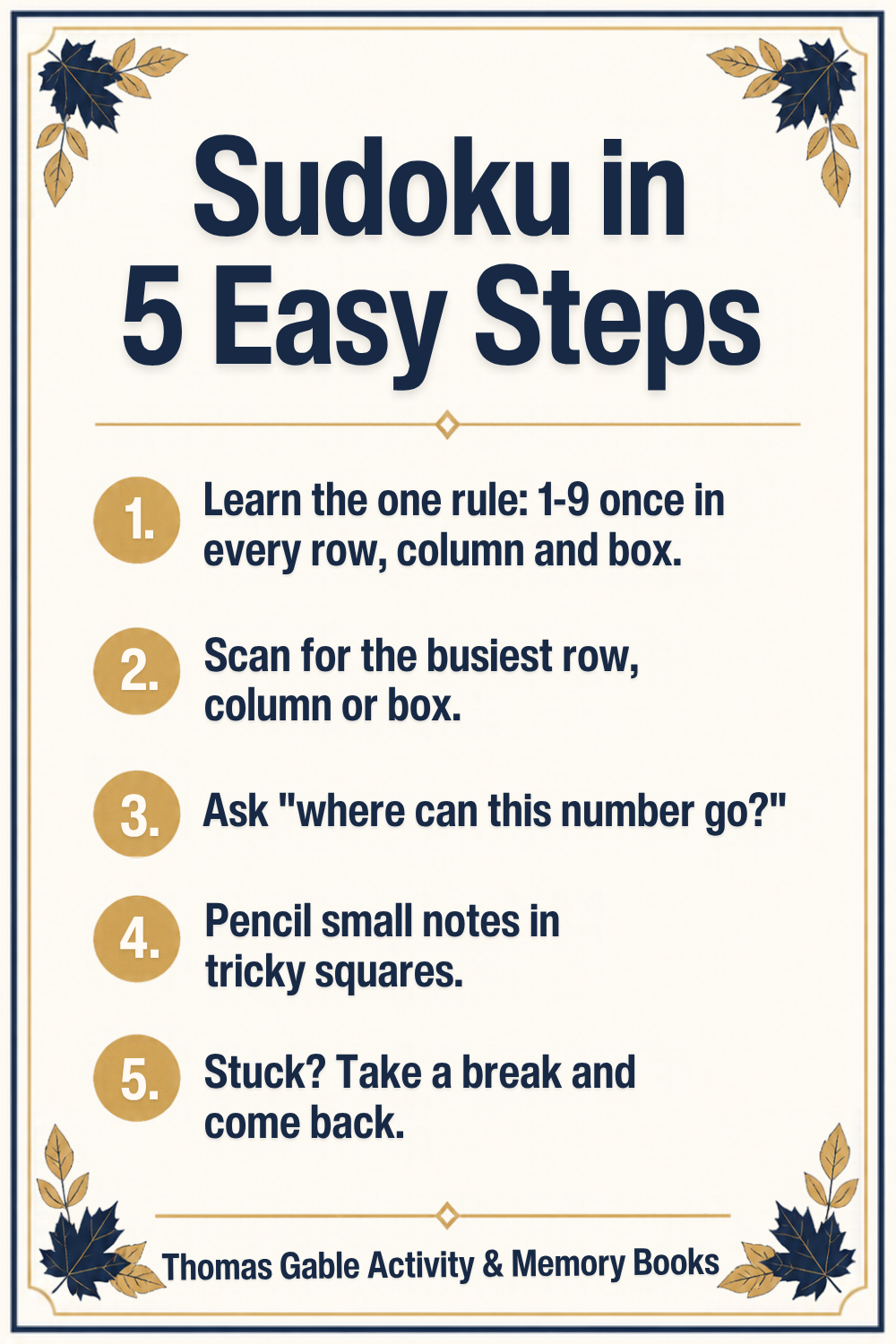
A standard Sudoku is a 9-by-9 grid divided into nine smaller 3-by-3 boxes. Some squares already have numbers. Your job is to fill the rest so that every row, every column and every box contains each number from 1 to 9 exactly once. That’s it. No guessing is ever required in a well-made puzzle; each number can be worked out from the ones already there.
Because the numbers are only symbols, you could play the same game with letters, colors or Thanksgiving pictures. Thinking of them that way takes the “math” worry right off the table.
Step 2: Look for the busiest spots
Start where the grid is most crowded. A row, column or box with only one or two empty squares is the easiest place to make progress. If a row already has eight numbers, the missing one is simply whichever number from 1 to 9 isn’t there yet.
A slow, steady scan works better than hopping around. Many solvers sweep across the rows from top to bottom, then down the columns from left to right, then box by box.
Step 3: Ask “Where can this number go?”
Pick a single number, say 5, and look at one box. Which of its empty squares could hold a 5? Cross off any square whose row or column already has a 5 somewhere else. If only one square is left, that’s where the 5 belongs. Then try the next number. This “one number at a time” habit is the heart of Sudoku, and it keeps the puzzle calm and manageable.
Step 4: Pencil in small notes, and know when to rest
When a square could hold two or three numbers, write them small in the corner with a pencil. As you fill in nearby squares, cross the options off until only one remains. A soft pencil and a good eraser are a Sudoku player’s best friends.
And if you get stuck, set it aside. Coming back after the dishes are done often makes the next move jump right out. Puzzles are meant to be enjoyable, not stressful.
Habits that help
- Working in pencil
- Following one number at a time
- Starting with the fullest row, column or box
- Taking breaks when you feel stuck
Habits that trip you up
- Guessing and writing in pen
- Jumping randomly around the grid
- Trying to hold every option in your head
- Pushing on when you’re tired
Try this: a mini Sudoku warm-up
Here’s a tiny 4-by-4 practice grid. The rule is the same, just smaller: every row, column and 2-by-2 box (the four corners of the grid) must contain 1, 2, 3 and 4 exactly once.
| ? | 2 | ? | 4 |
| 3 | |||
| 3 | |||
| 4 | 2 |
- Look at the top row. It already has 2 and 4, so the two question marks must be 1 and 3.
- Check the first column. It already has a 3, so the top-left square can’t be 3. It must be 1, which makes the other question mark 3.
- Move to the bottom row. It has 4 and 2, so it needs 1 and 3. The last column already has a 3, so the bottom-right square is 1 and the other empty square is 3.
- Finish the rest yourself using the same “what’s missing, and where can it go?” thinking. The full answer is at the bottom of this post.
Once that feels comfortable, you’re ready for full-size puzzles. Try one with a family member over the holiday weekend; two sets of eyes are great for spotting the next move.
Mini Sudoku answers
| 1 | 2 | 3 | 4 |
| 3 | 4 | 1 | 2 |
| 2 | 1 | 4 | 3 |
| 4 | 3 | 2 | 1 |

From Thomas Gable Activity & Memory Books, an imprint of Ripplebound Publishing
This post is for general interest and isn’t medical advice. As an Amazon Associate I earn from qualifying purchases.


Comments
One response to “Sudoku for Thanksgiving Week: A Step-by-Step Starter Guide”
[…] Sudoku for Thanksgiving Week: A Step-by-Step Starter Guide […]
LikeLike