
Every November, someone at the table asks the big question: “What are you thankful for this year?” It can feel like a quick ritual before the rolls get passed. But that simple question asks the brain to do something useful. It has to search back through the year, pick out a good moment, and put it into words. That’s gratitude and memory working together, and it’s worth doing more than once a year.
What researchers have found about gratitude
Gratitude has been studied by psychologists for years. Studies suggest that people who regularly take time to notice and write down things they’re thankful for often report a better mood, a more hopeful outlook and a stronger sense of connection with others. Researchers have also found links between gratitude habits and things like better sleep and lower stress for some people.
Gratitude isn’t a cure for anything, and it doesn’t replace real support when life is hard. It’s a small, free habit that many people find makes ordinary days feel a little brighter. If you have concerns about your mood, memory or health, the best next step is a conversation with your doctor.
Why gratitude is also a memory exercise
To say what you’re thankful for, you have to remember it first. “I’m grateful for the trip to see my sister in June” means pulling up the drive, the porch, the meal you shared. That kind of recall uses the same skills as a good memory game: searching, picking out details and putting them in order.
Thanksgiving is full of strong memory cues, too. The smell of sage and roasting turkey, a certain serving dish, the sound of a football game in the next room. Familiar sights and smells can bring back memories from decades ago, which is why so many family stories come out around this table.
Two ways to practice: quick or deep
There’s no wrong way to do this. Pick the style that fits your day and your energy.
Quick: 2 minutes
- Name three good things from today, out loud or on paper
- Add one detail to each: who, where, or what it looked like
- Great for bedtime or right after a puzzle
Deep: 15 minutes
- Choose one person you’re thankful for and write down a memory of them
- Include the sights, sounds and smells you remember
- Share it with them, or save it to read aloud at Thanksgiving
Try this: a Thanksgiving gratitude week
Thanksgiving is a little over two weeks away, which makes this a good time to start. Try one small habit each day this week. Caregivers can do these alongside a loved one, and grandkids can join in by phone.
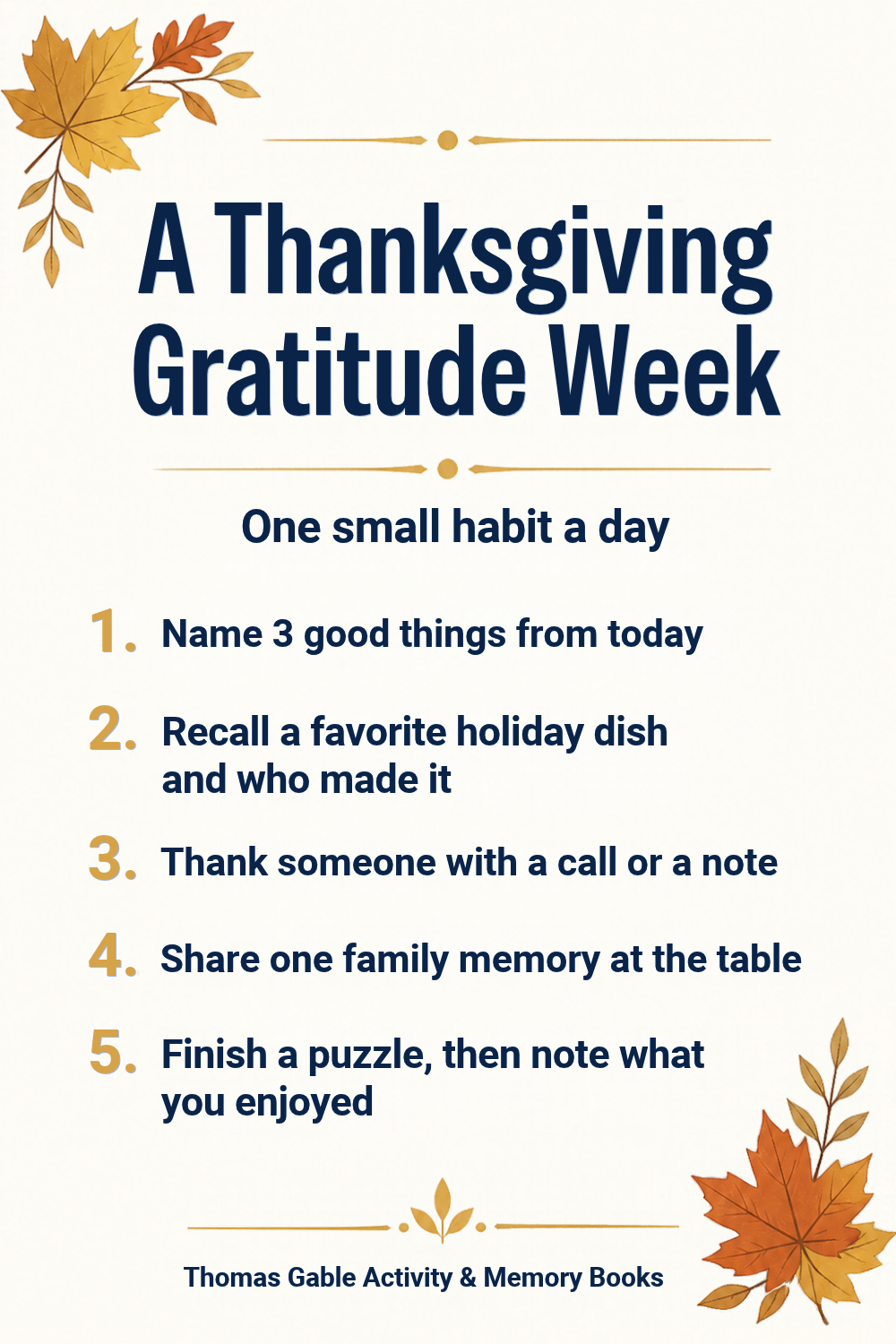
- Name three good things from today. Small counts: a sunny window, a phone call, a good cup of coffee.
- Recall a favorite holiday dish and who made it. Try to remember the kitchen, the dish it was served in, and what it tasted like.
- Thank someone with a call or a note. Tell them one specific thing they did that mattered to you.
- Share one family memory at the table. Start with “I remember when…” and see where the conversation goes.
- Finish a puzzle, then note what you enjoyed. A word you found fast, a fact you learned, or simply a quiet half hour.
Bringing it to the Thanksgiving table
On the big day, gratitude can be more than one quick round before dinner. Put a small card and pencil at each place setting and ask everyone to write one thing they’re thankful for and one Thanksgiving memory. Read them aloud over pie. Older guests often have the best stories, and younger ones love hearing what the holiday was like “back then.”
If conversation needs a nudge, a themed activity helps. The Thanksgiving Memory & Recall Activity Book, Gentle Edition has relaxed, one-per-page activities like picture searches and match games, and the Challenge Edition adds word searches, Sudoku and trivia for sharper solvers. Either one gives the table something to share while the turkey rests.
Try this: Tonight, before bed, name three good things from today and one detail about each. That’s it. Do it again tomorrow, and notice how much easier the good moments come to mind by the end of the week.
Gratitude doesn’t need a holiday, but Thanksgiving is a wonderful place to start. Print the plan, stick it on the fridge, and let this be the year the “what are you thankful for” question gets a really good answer.

From Thomas Gable Activity & Memory Books, an imprint of Ripplebound Publishing
This post is for general interest and isn’t medical advice. As an Amazon Associate I earn from qualifying purchases.

