Happy Halloween! Ghosts and goblins are fun, but some of the spookiest things on our planet are completely real, and many of them are made of water. A lake that turns red. A river hot enough to scald. Pools of water hiding at the bottom of the sea. Grab a flashlight and a curious kid, because today we’re exploring five creepy-but-true waters and the science that explains them.
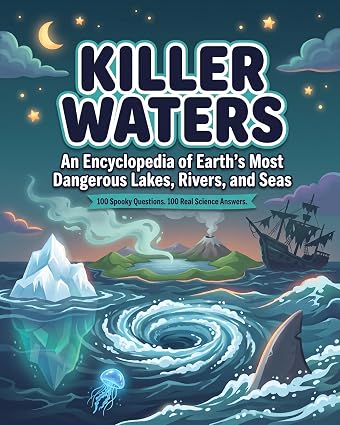
Ages 8-12 · Illustrated
Killer Waters
- 100 spooky questions about real lakes, rivers and seas
- 10 chapters, from Lakes That Can Kill to Creature Waters
- Every entry: the science, a danger rating and a survival tip
- Spooky questions, real answers, no gore
Five creepy waters that are totally real
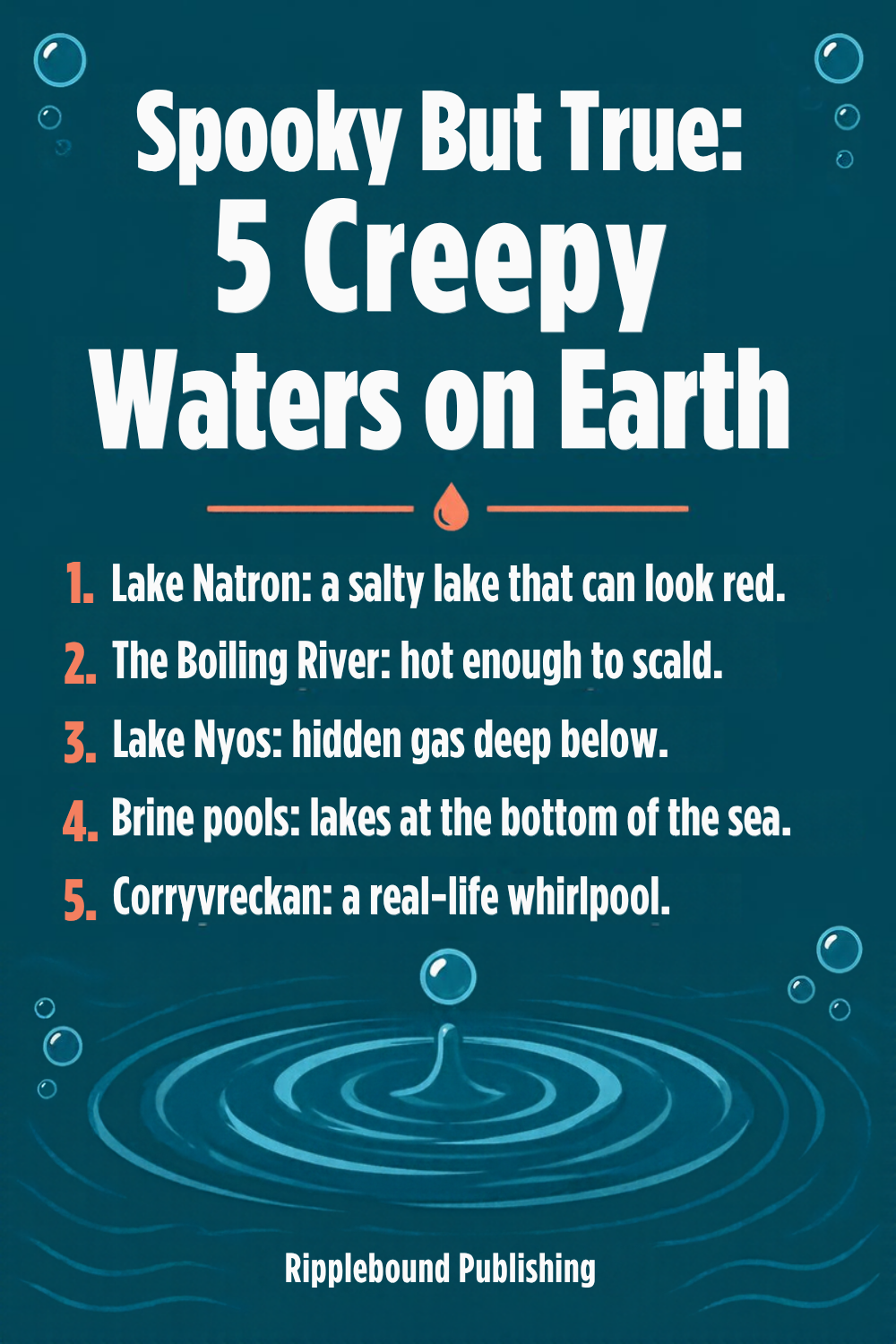
1. Lake Natron, Tanzania: the lake that looks red
Lake Natron is so salty and so alkaline (that’s the chemical opposite of acidic) that its water can sting and burn skin. Tiny salt-loving microbes can tint parts of the lake red and orange, so from above it can look like something out of a monster movie. Here’s the twist: lesser flamingos raise their chicks there, partly because most predators stay away from such harsh water.
2. The Boiling River, Peru: hot enough to scald
Deep in the Amazon rainforest, a river called Shanay-Timpishka steams like a giant cup of tea. It’s warmed by hot water rising from deep underground. Parts of it are hot enough to badly burn skin, so visitors stay on the banks and out of the water.
3. Lake Nyos, Cameroon: hidden gas deep below
Lake Nyos looks calm and blue, but carbon dioxide gas seeps into its deep water from below. In 1986, a huge amount of that gas escaped all at once, and sadly about 1,700 people living nearby lost their lives. Scientists learned from that tragedy. Today, pipes in the lake let the gas out slowly and safely, a little at a time.
4. Brine pools: lakes at the bottom of the sea
Yes, there are lakes under the ocean! On the floor of the Gulf of Mexico, some pools of water are so salty and heavy that they don’t mix with the seawater above them. They even have little “shorelines.” The water has almost no oxygen, so most animals that wander in can’t survive, but some tough microbes and mussels live right along the edges.
5. Corryvreckan, Scotland: a real-life whirlpool
Between two Scottish islands, Jura and Scarba, fast tides rush over a bumpy seafloor and an underwater rock pinnacle. The water swirls into one of the biggest whirlpools in the world. Sailors plan their trips around the tides so they don’t get caught in the spin.
So what makes water dangerous?
Look closely and you’ll spot the same few culprits: heat (the Boiling River), chemistry (Lake Natron’s salty, alkaline water), gas (Lake Nyos), density (brine pools) and moving water (Corryvreckan). Scientists study each one so people can stay safe, which is why the best real-life rule is simple: stay out of water you don’t know, follow posted signs, and always swim with an adult nearby.
Try this: make a brine pool in a jar
You’ll need: a clear glass or jar, salt, warm tap water, food coloring, a spoon and a cup of plain water.
- Fill the jar about one-third full of warm water. Stir in a few big spoonfuls of salt until most of it dissolves.
- Add a few drops of food coloring and stir. This is your salty “brine.”
- Hold a spoon upside down just above the colored water. Very slowly pour plain water over the back of the spoon so it trickles gently on top.
- Look from the side. The heavier salty water stays at the bottom, with a clear layer floating above it, just like a brine pool on the seafloor.
- Wait an hour and check again. What changed? (Over time, the layers slowly mix.)
Talk about it
- Which of the five waters would you most like to see (from a safe distance)? Why?
- Why do you think flamingos can live at Lake Natron when most animals can’t?
- How did scientists make Lake Nyos safer? Can you think of another problem people solved by studying nature?
- What’s one water-safety rule your family follows at the pool, lake or beach?
Brave enough for 95 more?
These five are just a taste. Killer Waters packs 100 spooky questions into 10 chapters, from caves and blue holes to ship graveyards and frozen seas, each with a short answer, the real science, a danger rating and a survival tip. It’s a perfect not-too-scary read for Halloween weekend and beyond.

From Ripplebound Publishing · Kids’ Books
As an Amazon Associate I earn from qualifying purchases.

